Burning Firewood
When winter approaches and fuel costs remain high, people turn their attention to alternative fuels. One of our oldest and
most reliable sources of heat is firewood. Any homeowner that has
a wood-burning stove or furnace is ready to offset the high cost of
fossil fuels.
How much can you save on fuel costs? Heat is commonly measured in
British Thermal Units (BTUs). One BTU is equivalent to the amount of
heat that it takes to heat one pound of water (1 gallon equals 8.34
pounds) by one degree fahrenheit. A cord of mixed hardwood, when
burned, produces approximately 19 million BTUs of heat. It takes
135-140 gallons of #2 fuel oil to equal that amount of heat. A cord of
firewood in this area costs approximately $250.00 and #2 fuel oil
fluctuates and has often been over $4.00 per gallon during the past few
years. Ask yourself how much fossil fuel you used last year.
Now do the math. It won't take long for a wood burning stove to pay for
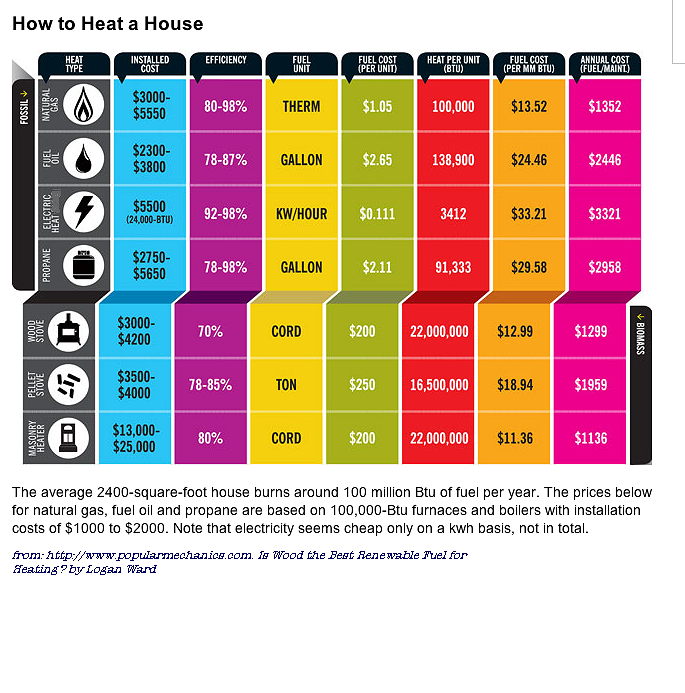
itself will it? Below is a fuel comparison chart that Popular Mechanics published a couple of years ago:
Please, use reputable professionals for the installation and
maintenance of your wood burning appliance. They are aware of national
and local fire-codes. Remember that if you use a wood stove all season
to have a chimney sweep clean your chimney once at the beginning of the
season and at least once during the heating season.
If you don't have your own source of firewood you will have to buy it.
Here are some tips: Firewood is measured in cords, one cord is four
feet wide, eight feet long and four feet tall when stacked neatly. A stacked
cord is the basis of comparison shopping. If you don't have the time or
means, you will probably have your wood delivered. If however, you do
have the time and means some firewood dealers will let you pick up your
wood from them and
pass a savings on to you. Start with local dealers.
Remember that the farther they have to bring your wood, the more it
costs them in both time and fuel. Because of invasive insects--such as
the emerald ash borer-- there may be legal restrictions on transporting
firewood over state or county lines. It's a good idea to buy your firewood locally. Before you buy, ask the dealer how
they load their truck. Do they stack the wood in the truck or do they
load it with a machine? The difference can be significant. If the wood
is stacked on the truck, then it's very easy to determine whether or
not you will get a full cord. Remember, a cord is a measure of
stacked wood--not a cubic measure of a truck bed. Some dealers will
quote a price for dumping wood in your driveway. This can save you some
money if you are willing to move and stack the wood yourself. Other
dealers will quote a price for unloading and stacking the wood a
reasonable distance from their truck. A reasonable distance may be
about 75 feet or less and does not include stairways. Realistically, a
reasonable distance may be the distance from your driveway to the back
of your house. If you want it moved up a stairway and onto a deck or
very far from where the dealer may park their truck, be prepared to pay
extra.
This winter the savings from using a wood-burning heat source will
probably be significant. Even if you have to buy your wood and have it
delivered, a smart shopper can realize a savings. Remember to shop
local first.
A few other things you need to know about safely burning firewood---